
Artist Profile: Prima Jalichandra-Sakuntabhai
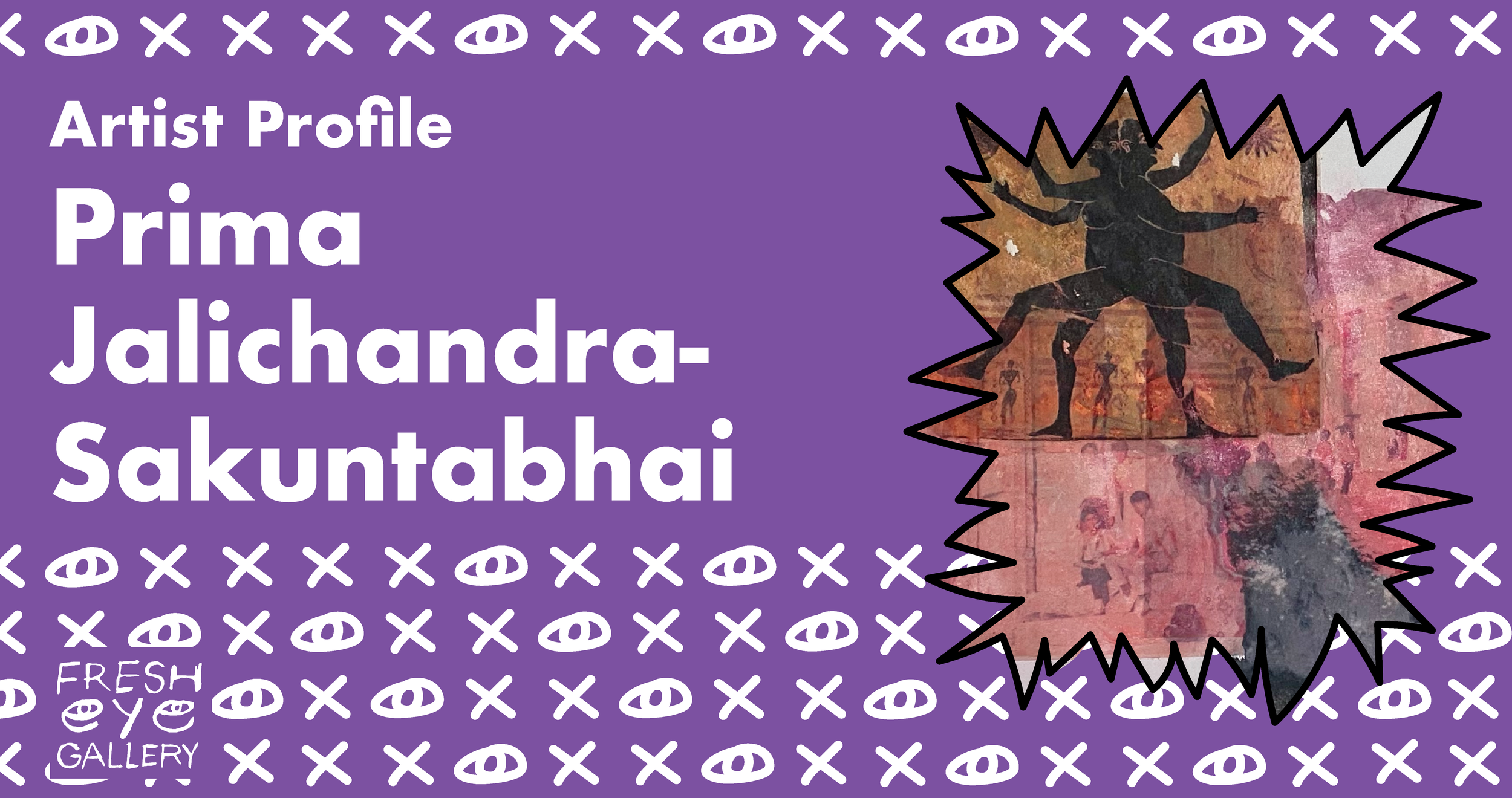
Join us as we catch up with artist Prima Jalichandra-Sakuntabhai!
Prima (they/them) is a transdisciplinary artist, curator and art worker, currently based in St Paul, Minnesota. They received a Visual Arts Degree from the Ecole des Beaux Arts de Nantes Metropole and a License in Film Studies at the Sorbonne Nouvelle-Paris 3. They hold a BFA from the School of the Arts Institute of Chicago and a MFA from the California College of the Arts, San Francisco.
Prima is a prolific artist and curator. Their work has been widely exhibited in the United States and internationally, while their curatorial projects involve cross-cultural collaborations between artists working in different parts of the world.
Their works have appeared in publications, such as Hyperallergic, Carla, Artillery Magazine and the Performance Art Journal and Thai online media, such as the101.world and [BOOKMARK MAGAZINE], an initiative of BANGKOK CITY CITY GALLERY. They received the SOMA Summer Award to attend the SOMA residency in Mexico City in 2016 and was awarded the California Arts Council 2023 Individual Artist Fellowship. Prima is currently a resident at Second Shift Studio Space in St. Paul, and was recently announced as a 2026 McKnight Visual Artist Fellow.
You can see two of Prima’s pieces, “174” and “My Father Ruminates on the Origin of Love” at Fresh Eye Gallery from April 23-May 31, 2026 as part of What Follows, curated by Bo Young An.
Learn more about Prima’s practice and get a glimpse of the inspiration behind their work in the interview below!
Fresh Eye Gallery: Tell us about your pieces, “174” and “My Father Ruminates on the Origin of Love.”
Prima Jalichandra-Sakuntabhai: Both works are issued from a research project, 174 / Neung Jed Si- A Short History of Thailand (2025), that uses my family archive to create a mythic origin story for our chosen exile from Thailand. During my recent visits to my childhood home in Bangkok, I’ve unearthed family photographs, letters and documents that pertain to our family’s history and experiences living abroad. I spread them out on beds and furniture so I could look at them. They began to feel part and parcel of the architecture: the house from which we depart becomes a keeper of memories. I also inserted my body as another receptacle for these tokens from the past. How else do you keep memories in the present?
These images are presented in a slide projection, titled Neung Jed Si after the address of our home, mimicking the way old family photographs are shown.
PJS (cont.): My Father Ruminates on the Origin of Love is a collage using image transfers from scanned photographs of my father visiting Greek ruins overlayed with representations of gender-ambiguous deities illustrative of the myth of the Origin of Love. In the myth, humans were originally created as complete, rounded beings, both male and female. Out of jealousy, Zeus threw his thunder at the humans and split them in half. Love is the quest for this other missing half. A love letter from my father to my mother hovers above a figure writing a letter- the act of writing letters romanticizes longing for the beloved who is often, always absent. His solitary figure, repeated twice in the composition, infers that love is laced with loneliness.
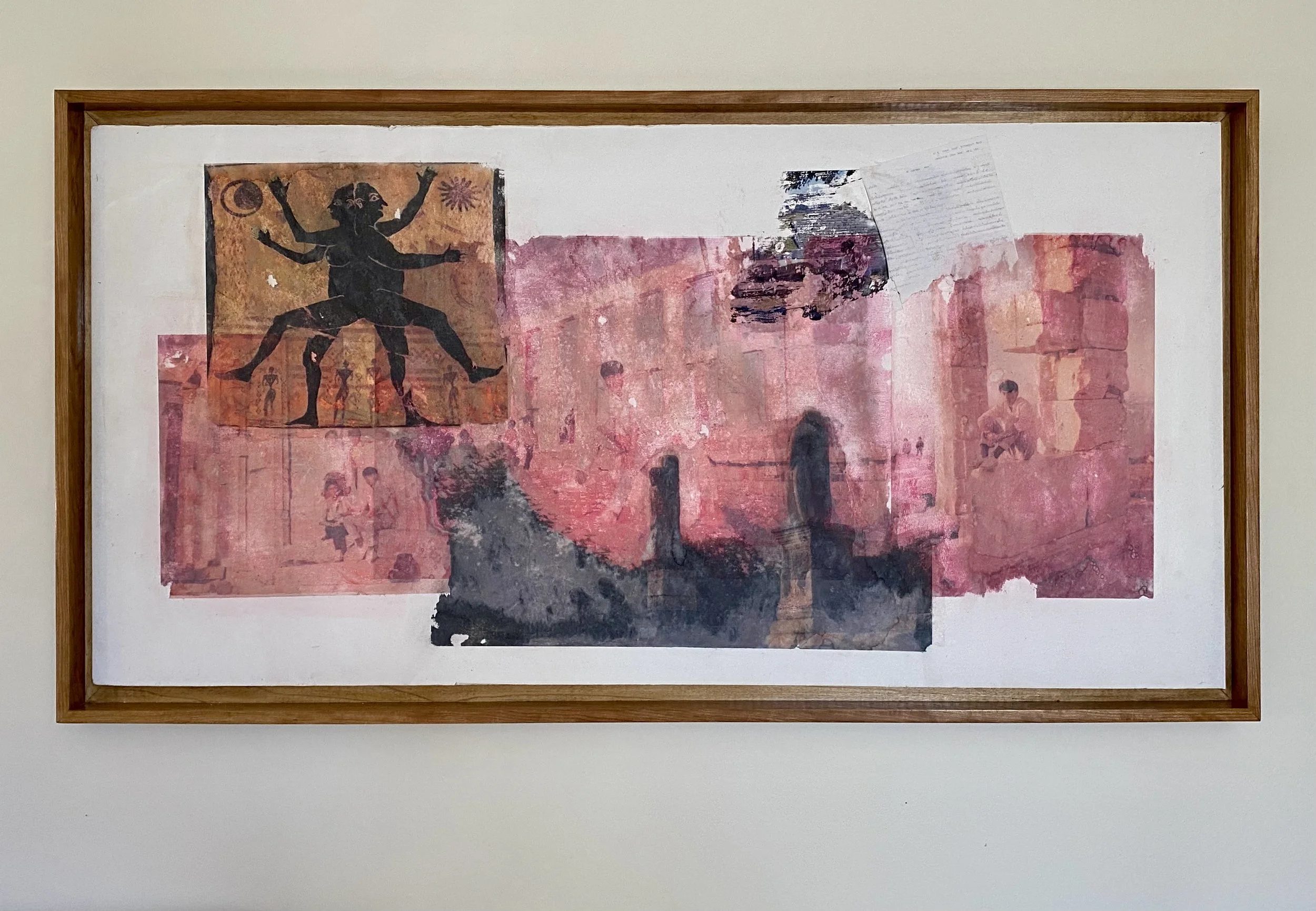
Prima Jalichandra-Sakuntabhai, My Father Ruminates on the Origin of Love,2025; 24×48 inches; Image transfer photographs and mixed media on drywall, framed.
FEG: Tell us about your process.
PJS: I have found that I often need to carve out intentional time- to read, to make encounters, to be present and observant, before materializing an art project. I try not to force things into being but rather, wait for an auspicious meeting, a chance encounter between the different elements that I’ve been thinking about, observing, remembering, discovering, for things to naturally fall into place. My making process varies with each project but they often involve layering, superimposing, collaging, collaborating (with the past, with other artists, musicians, writers, communities, light, etc…), taking things apart, fragmenting, obscuring, revealing. Because I tend to employ different mediums for each new work, I use it as an opportunity to connect with people who are more experienced and knowledgeable in that process than me. I do believe that, while art appears as a solitary endeavor, you are never truly the sole creator of an art piece.
FEG: What is your preferred medium? How does the medium affect your work?
PJS: I have been saying that my medium is research, as it is the primary and most consistent material I have used throughout my different projects. All my projects start with a research inquiry, whether it is through books, visual searches on the Internet, traveling to places I have lived in, personal memories or communal knowledge. I combine these various sources of information into performative lectures, video essays, installations, sound collaborations, artist books and most recently, glass etchings. I enjoy recycling research materials throughout different works, like visiting an old friend or a familiar place and seeing how their meaning has changed when presented in a new context.
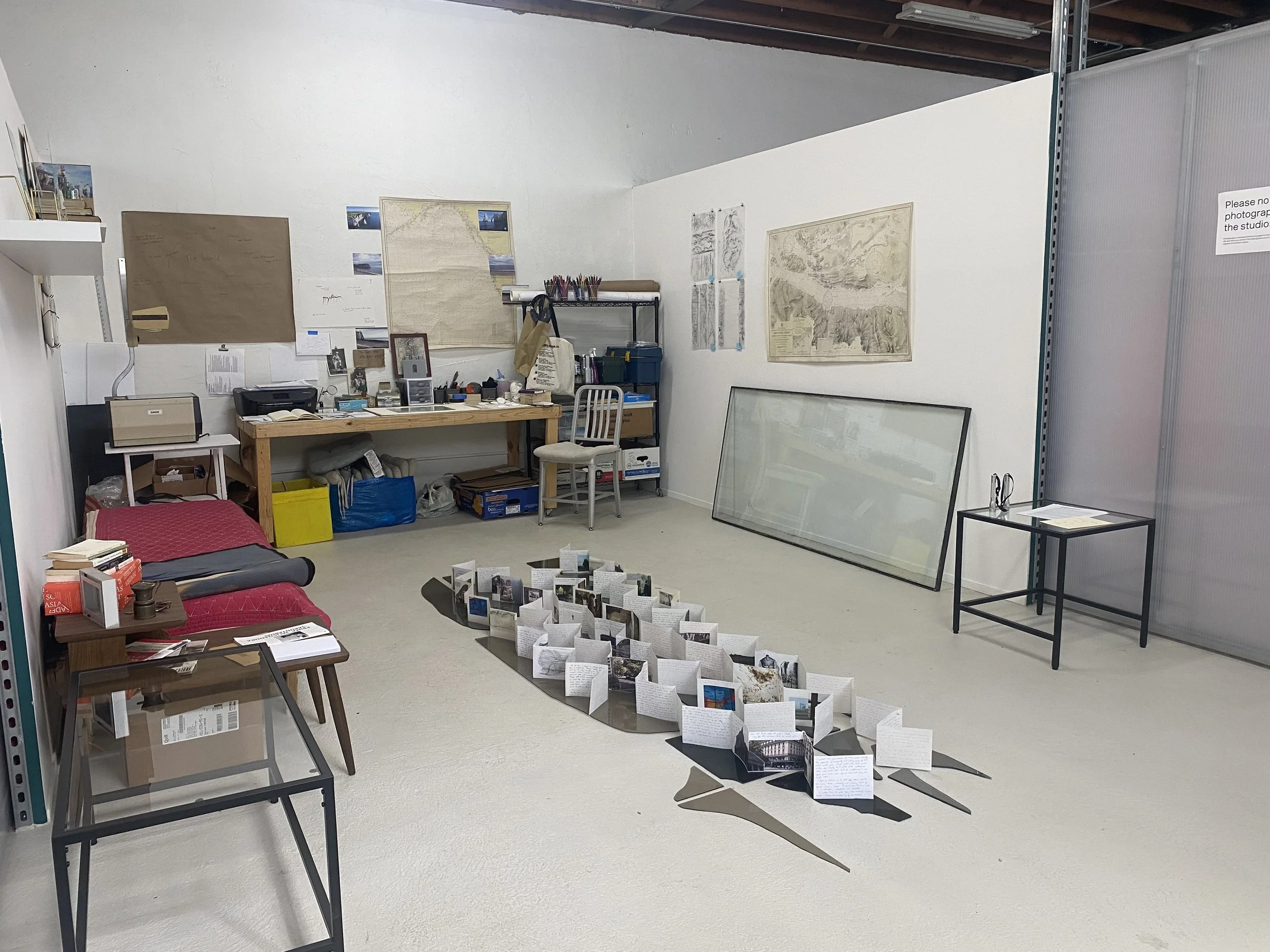
Image of Prima’s studio in the Second Shift Studio space.
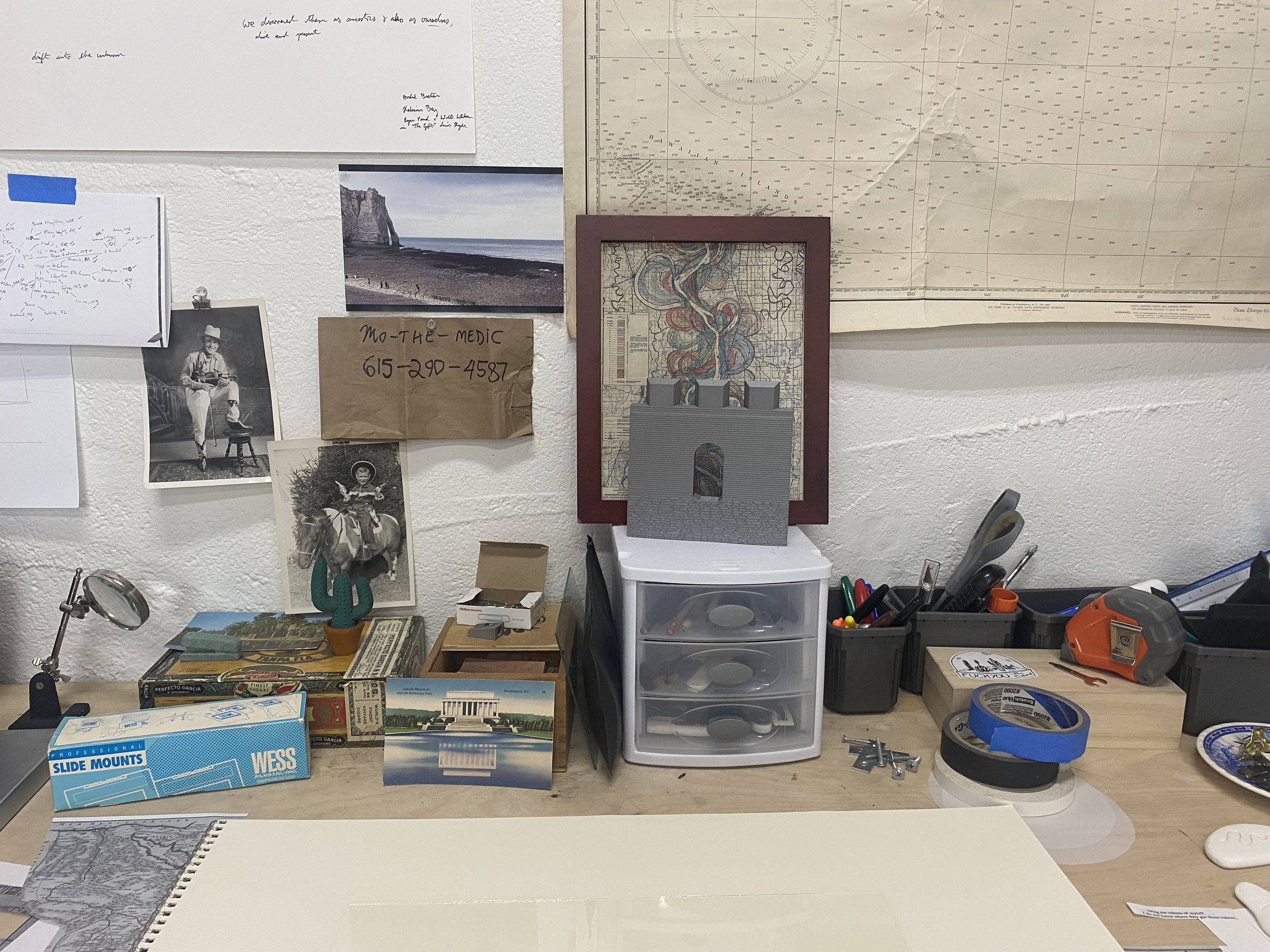
Detail image of Prima’s studio in the Second Shift Studio space.
FEG: Have you shown work with Fresh Eye Gallery before? How did you learn about us?
PJS: This is my first time showing work with Fresh Eye Gallery. I first heard of the gallery from my friend, Barak ade Soleil who asked me to come on as a consultant for their Yearly Emerging Practices program. My [Second Shift Studio] studiomate, Meher, also happens to work there as their Gallery Coordinator. When I saw Bo’s open call, not only did I resonate with the curatorial vision, but I also felt a strong connection with the space and wanted to participate as an artist.
FEG: Where are you from? What has been your experience with art in the Twin Cities?
PJS: I moved to the Twin Cities two years ago from LA. Part of the reason why I decided to move was because I have met artist friends who told me how supportive Minnesota is of the art community. Artists seem to be able to support themselves while making art and some even own their homes, which is unheard of in a place like LA! I was ready to move to a more sustainable place and have a healthier relationship between my personal life, work and art. Through initiatives like Springboard for the Arts, Second Shift Studio Space, the Twin Cities Maker and my own growing art community, I have felt supported and inspired to experiment with different ways to engage with art outside of my studio practice. Without the stress of a high cost of living, I am more mobile and allow myself to leave more often for residencies, projects, research trips and pleasure ones.
I also am moved by how many people I encounter have a creative practice, even if they do not identify as an artist. I value the fact that art has a place in daily life here, not just as a privileged practice only a few can afford.
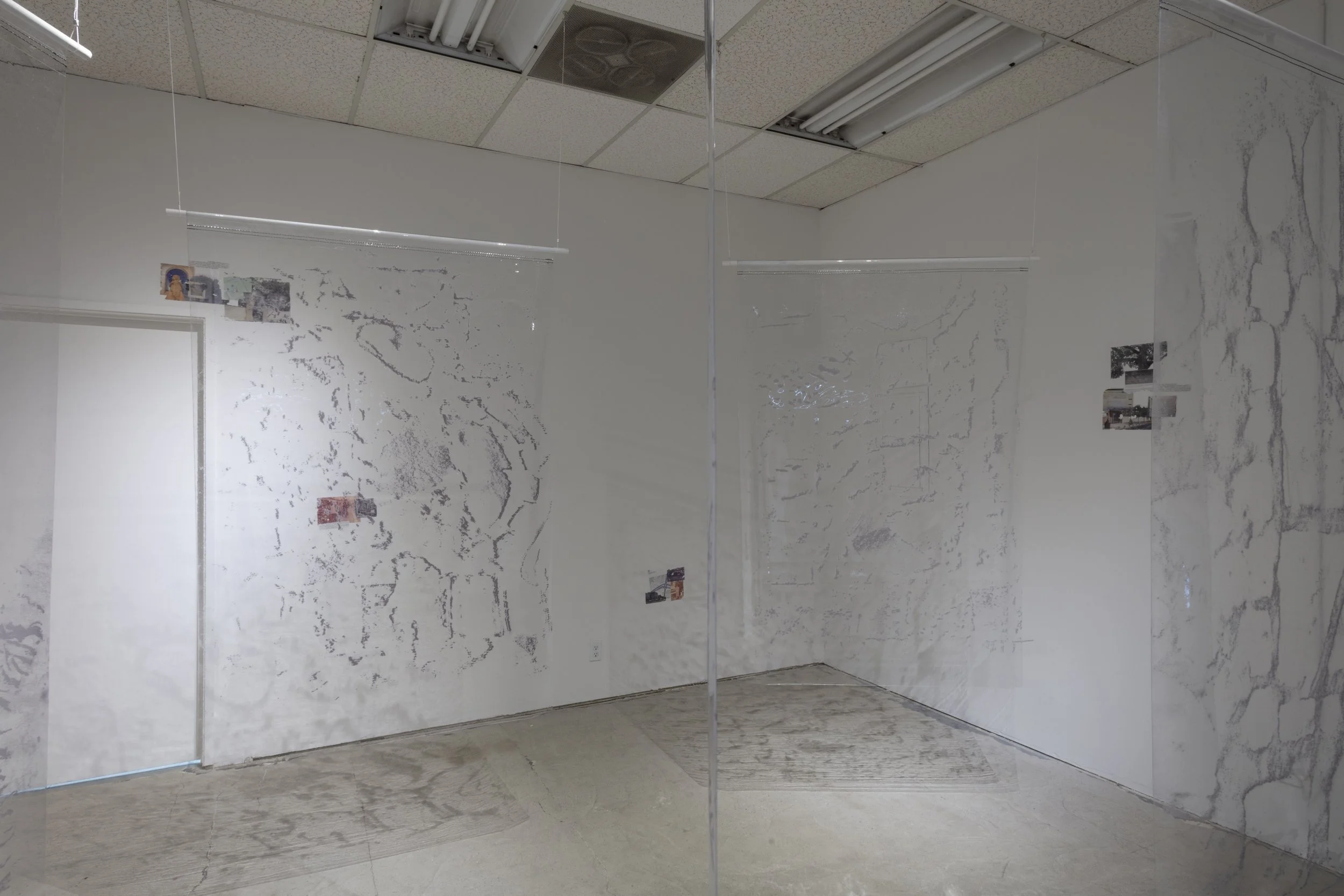
Prima Jalichandra-Sakuntabhai, “Pridi in Paris,” installed at the Fulcrum Press, in Los Angeles Chinatown, CA, 2024. Photo credit: Josh Schaedel.. Photo credit: Josh Schaedel.
FEG: What has been a favorite exhibit or piece in the last five years (or ever)?
PJS: I visited the New Museum in New York in April and saw a multi-channel video installation by UK artist, Christopher Kulendran Thomas, The Finesse (2022). On one side of the room, 5 LED screens show fragmented video interviews with three women, a Tamil independence fighter, a Tamil dancer and a deep-fake Kim Kardashian. Each in their own way, they discuss the limits of the nation-state and Western democracy as well as the violence that ensued as a result of colonization. Across the room, is a projection of a rainforest. When the screens become blank, we see ourselves in the reflection of the forest. I was particularly seduced by the utopian vision of the Tamil independence fighter and her articulation of a true democracy. I am drawn to this piece for rendering political theory tangible through the lived experiences of these women, joining their particular stories with the larger history of the struggle of the Tamil people. It was an effective immersive experience, where the viewers are implicated through the confrontation with their own image, faced with the reality of losing grasp on our own democracy.
FEG: What are you reading? Watching? Where are you travelling?
PJS: For the past two to three months, I have been imbued by the poetic and philosophical ponderings of Bayo Akomolafe. I attended his online classes through Macalester and am avidly reading his book, Selah. Unlike traditional thinkers who come up with a theory and arguments to defend it, Bayo unlocks our preconceived notions of what is truth and reality, connecting us to the infinitesimal of microbes and the ever-expanding sense of time beyond human chronology. He rewrites myths, leans on the wisdom of folktales, gives an apocryphal dimension to the last words of Renee Good, the shattering of reality behind the BAFTA Incident, the cracks in the Lincoln Memorial that let swamps in, contaminating the marble of democracy… These are just some of the few imageries he conjures to challenge our understanding of the world we live in and our roles within it. Another beautiful book I encountered recently is, On The Calculation of Volume (Book I) by Salveg Balle in which the protagonist is trapped in a single day that repeats itself 365 times. In a book where nothing happens, we are reminded of the heartbreaking impulse to make meaning of the world when the world flows by without us.
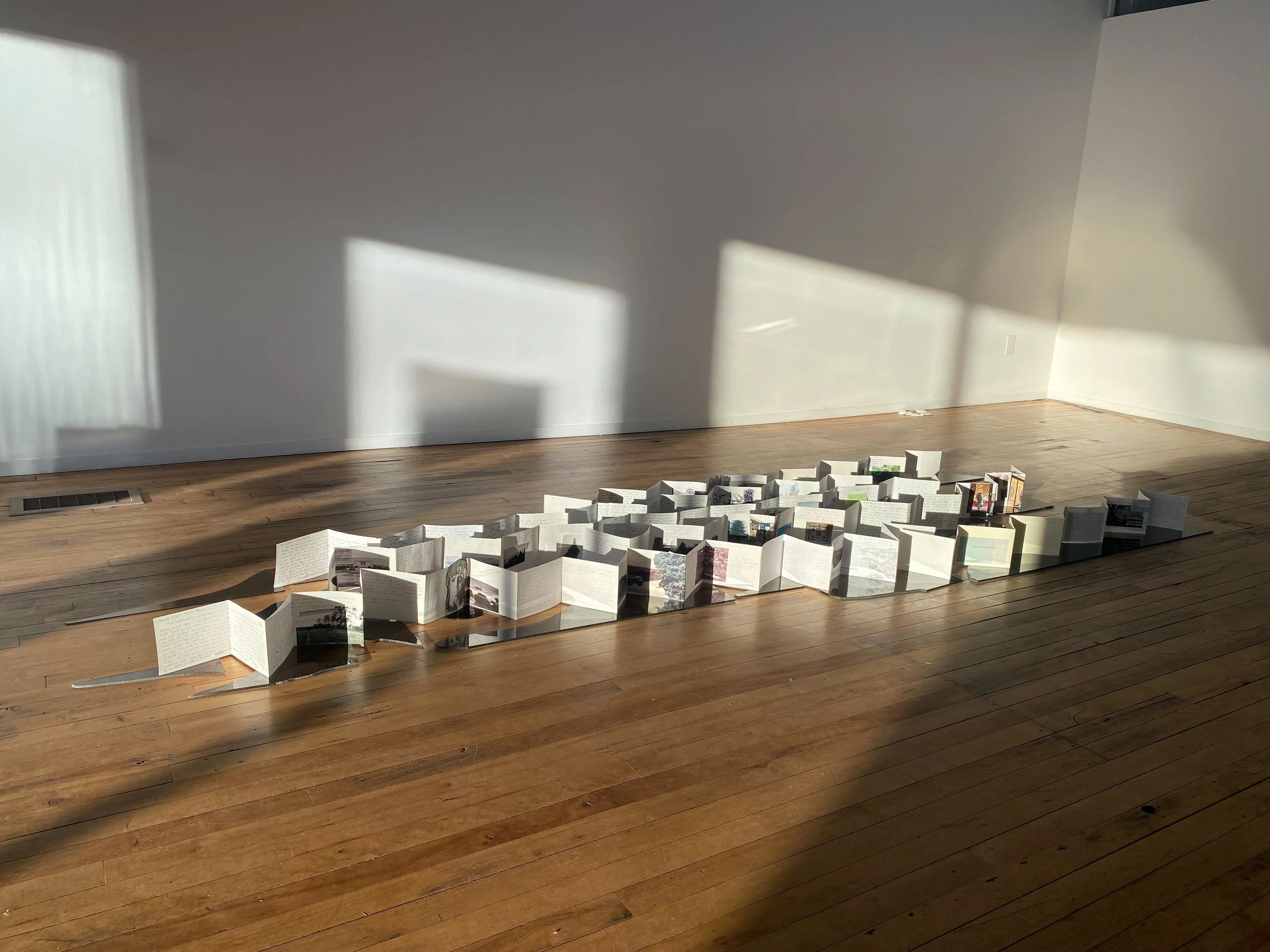
Prima Jalichandra-Sakuntabhai, Sealogs, 2025; Writing and collages on paper folded into an accordion, placed on tinted acrylic shards. Photo credit: Emily Dzieweczynski
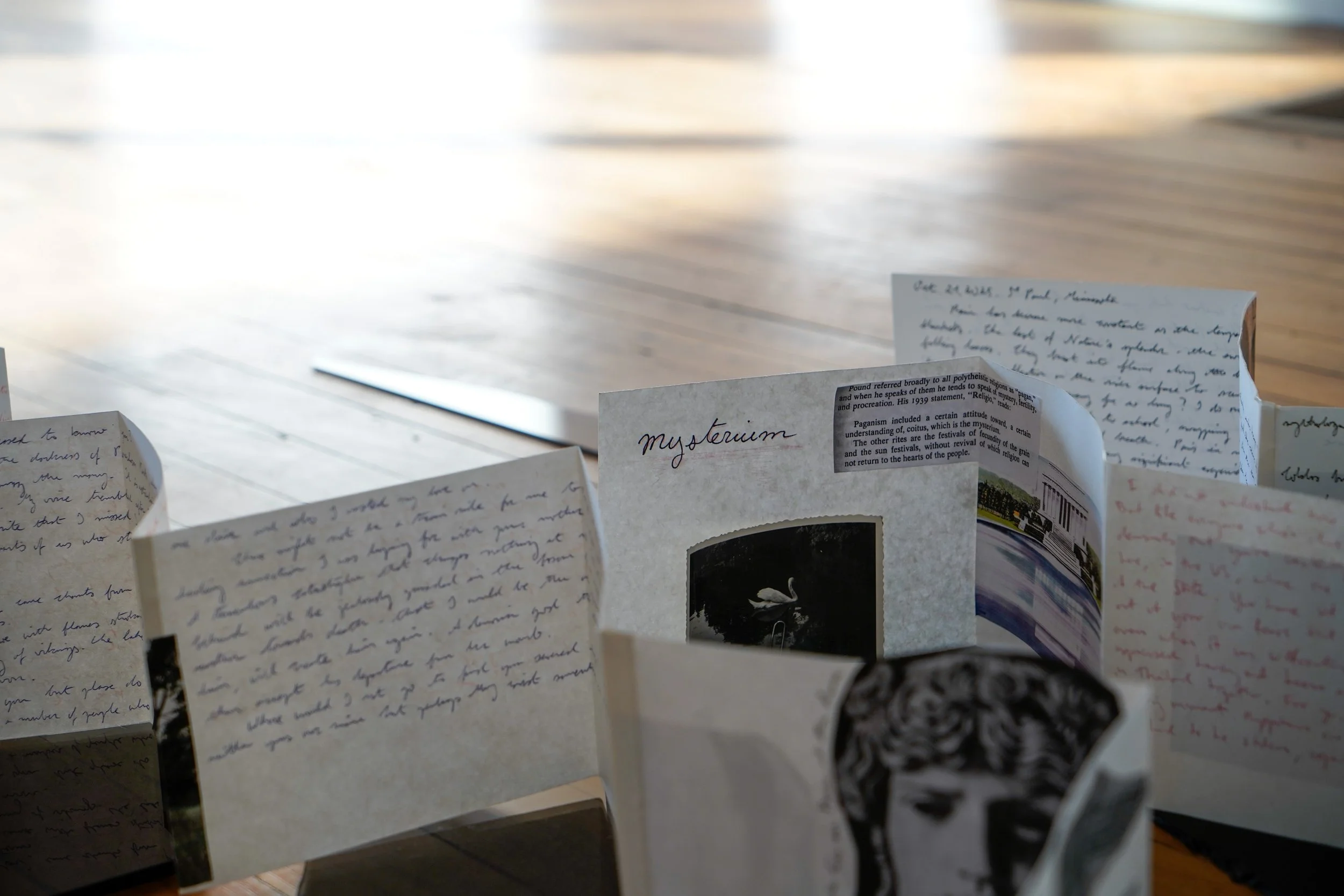
Detail of artwork installation, Sealogs, by Prima Jalichandra Sakuntabhai. Photo credit: Emily Dzieweczynski.
PJS (cont.): Since my move to the Twin Cities, I have been traveling back to Los Angeles quite frequently. These trips, mostly for art opportunities, are also a chance to travel back in time, to contend with who I was and who I could have been if I had stayed. Reels of memories replay themselves as I go through the familiar streets. As long as I can still navigate them without a map, the city still belongs to me. I also went back to Paris last winter, after the passing of a dear friend from my teenage years. The city appears frozen to me, only memories are left to make meaning of the streets and places I walk by. The actors have left the stage. It is a different city now. Whenever I want to go to France, I have to suffer the humiliation of asking for a tourist visa. Never mind that my parents still live there, never mind that I went to school all the way to college, never mind that I had come into my adulthood there and have made life long friends.
A different kind of memory was built from my recent trip to Short Mountain Sanctuary in Tennessee where I experienced myself in a long lineage of gay history in the US. I am a traveler who walks backwards in time to find ancestry and kinship in other people’s countries.
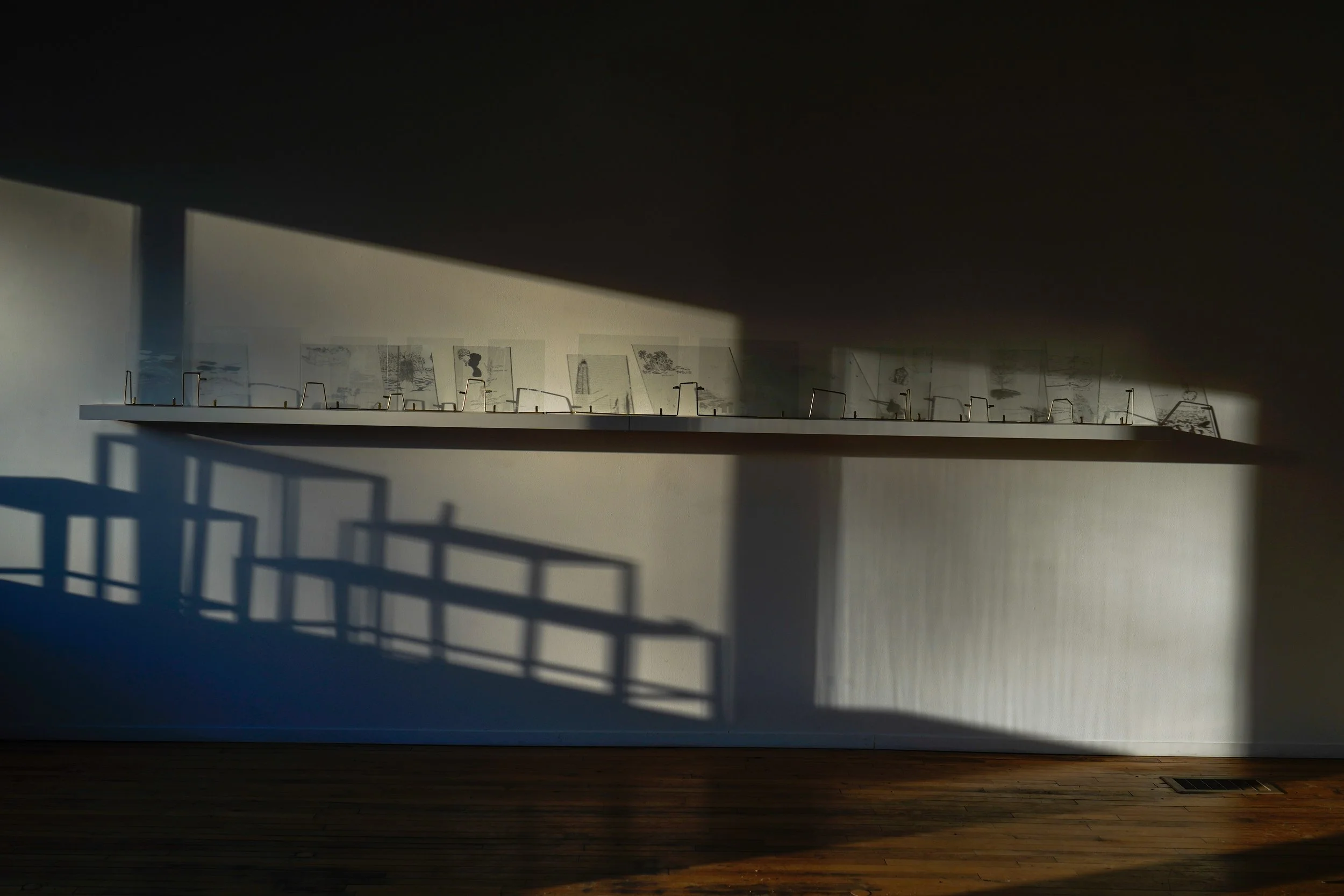
Prima Jalichandra-Sakuntabhai, Hieroglyphics- the Apotheosis of Antinous, 2025; Glass etchings, panels of 8x10 and 11x14, custom brass display 144” long. Photo credit Emily Dzieweczynski
FEG: Was art a part of your childhood?
PJS: Yes, my mother put me into art classes early on. I studied drawing, painting, pottery and also took theatre classes in school. I wrote a lot of short stories, poems and finished two novels when I was in my early teenage years. Growing up in countries where I did not necessarily speak the language, art was a place where I could find my expression and create an interior world for myself, composed of myths and legends, some were invented, others told to me.
FEG: What is your definition of an artist?
PJS: A person who makes rules so that they can break them.
FEG: Why do you make art?
PJS: I’ve been making art most of my life, it is difficult to separate myself from it. Throughout the years, art has become the way I understand and process the material reality around me. I am constantly making meaning out of daily life, asking myself the questions, why am I here? What or who am I supposed to be witness to? What is my relationship to [blank]? Living between different cultures, in a body considered as ‘Other’, the space and time created through art afford me a schism in reality where this fragmentation, this being in-between and envisioning a future of belonging beyond geographical and political borders, makes sense. For me, art is the last realm of freedom in human expression. It allows us to imagine what is not yet here and so, it is at once contingent and necessary.

Detail of installed artwork by Prima Jalichandra-Sakuntabhai, Hieroglyphics- the Apotheosis of Antinous. Photo credit Emily Dzieweczynski
FEG: What are you working on now, or what are you working on next?
PJS: I am working on a nation-wide participatory project called, Ruins of a Nation, featuring trans bodies as markers of ruins and decay across the United States of America. By situating trans individuals among sites of colonial violence, economic collapse, or environmental negligence, I juxtapose those perceived as "threats" against the material manifestations of the U.S. imperialist machine.
Starting from my own kinship network, I am reaching out to trans peers to act as "wardens" of their local landscapes. Their participation provides the lived experience necessary to reimagine belonging beyond the rigid unity of the nation-state.
The immersive installation consists of three alternating video projections out of 50 video submissions from trans participants across the country. The projections appear and disappear like dancing figures, their movement across the fabric screens, mimicking old school maps, form a fragmentary cartography. A sound piece accompanies the video: my retelling of my journey to Short Mountain Sanctuary in May of this year, a gathering of radical faeries in Tennessee, parsing through the entanglement of gay and trans histories. This voyage in time requires viewers to physically navigate the space, filling in the blank intervals and placing their own bodies in direct relation to the projected figures. In refusing to reconstitute a "whole," the fragmented nature of the work offers a counter-dominant orientation that contrasts with the exclusionary unity of a nation-state’s promise.